
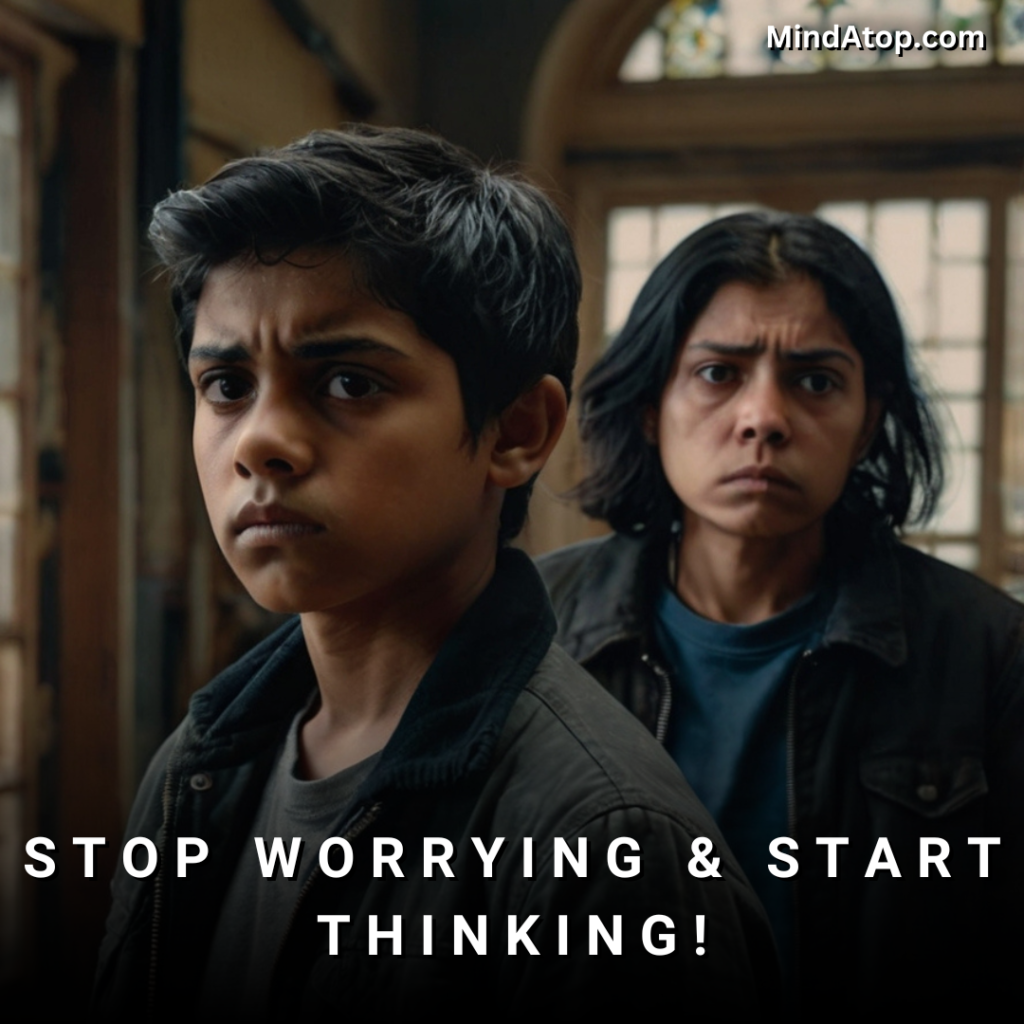
STOP Worrying and START Thinking
Stop Worrying and Start Thinking: Transforming Anxiety Into Thoughtful Action
Mrs. Sampat found herself increasingly consumed by worry and anxiety about her son, Rana. As he approached Class 8, she noticed his academic performance was declining, and his behaviour was becoming more erratic. Rana, once a bright and cheerful boy, now seemed distant and prone to outbursts of anger. Mrs. Sampat realized that in order to truly help him, she needed to stop worrying and start thinking! rather than letting anxiety drive her actions, yet old habits made it difficult to implement this shift immediately.
Mrs. Sampat’s husband worked out of town, leaving her to manage the household and her son’s issues largely on her own. With each passing day, she grew more restless and sleepless, her mind filled with concerns about Rana’s future. She believed that if she just pushed harder—checked his homework more rigorously, enrolled him in more tutoring sessions, and imposed stricter rules—he would improve.
However, her well-intentioned efforts only seemed to drive Rana further away. He began to resent his mother’s constant monitoring and criticism. Their interactions became tense, with arguments erupting over the smallest of things. Rana started avoiding conversations with his mother, and when pressed, he would respond with defiance or silence.
The stress in their home escalated as Mrs. Sampat’s anxiety spilled over into every aspect of their lives. She struggled to balance her concern for Rana with the demands of her own work and managing the household. The pressure mounted, creating a tense atmosphere that affected everyone in the family. It was only when she reminded herself to stop worrying and start thinking that she began to consider more thoughtful ways to help her son.
One evening, after another heated argument with Rana, Mrs. Sampat found herself watching a movie about a similar mother-son relationship. As she observed the on-screen dynamics and saw herself mirrored in the character, a moment of clarity dawned on her. She realized that her constant worry and anxiety had blinded her to the impact of her own behaviour on Rana.
Reflecting deeply, Mrs. Sampat understood that her approach was not helping Rana—it was hurting him. Her anxiety-driven actions had eroded their trust and strained their bond. She saw how her relentless worry had prevented her from seeing the root causes of Rana’s struggles and from supporting him in a constructive way.
This realization marked a turning point for Mrs. Sampat. Instead of continuing down the path of worry and control, she resolved to change her approach. She began by taking a step back and giving Rana space to express himself. She started listening more and lecturing less, seeking to understand his challenges and frustrations.
Mrs. Sampat made a conscious effort to offer encouragement and support rather than criticism. She created a calm and nurturing environment at home, where Rana felt safe to share his concerns and seek guidance without fear of judgment.
It wasn’t easy at first. Rana was wary of his mother’s sudden change in behaviour and remained guarded. However, as Mrs. Sampat persisted with patience and understanding, Rana gradually began to respond. He started to take small steps towards improving his academics and managing his emotions better.
Their journey was filled with ups and downs, but Mrs. Sampat’s decision to stop letting worry dictate her actions and to start thinking critically about how to support her son ultimately paid off. Their relationship gradually strengthened, built on a foundation of trust, respect, and mutual understanding. By consistently reminding herself to stop worrying and start thinking, she found a balance between care and guidance that nurtured both her son and herself.
Through this experience, Mrs. Sampat learned the valuable lesson that worrying excessively doesn’t solve problems—it exacerbates them. By shifting her focus from anxiety-driven actions to thoughtful and compassionate strategies, she not only helped Rana navigate his challenges but also fostered a healthier and more harmonious family dynamic.
Must Read Stories:
Where do you Stand? – “You’ll never shift your path until you pause and check your stance.”
The Web of Reaction – “Reactions aren’t decisions. Break the loop.”
Just Pay Attention to Solve Anything – “Still wondering what attention can do?”